


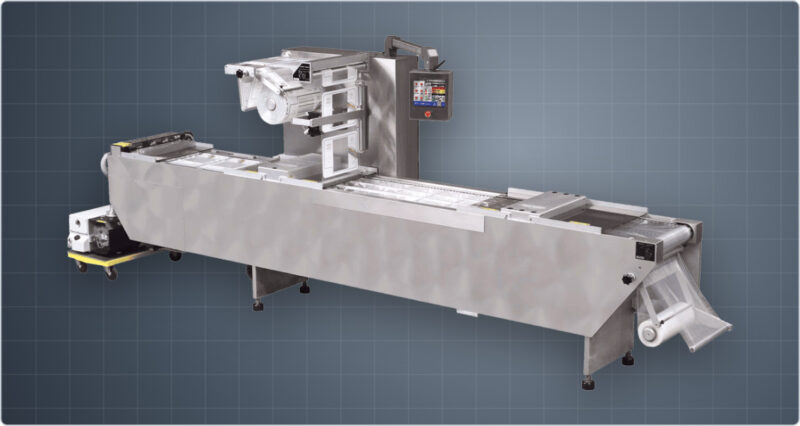
Rollstock thermoforming creates the package from roll-fed material inside the machine; tray sealing closes a supplied tray; chamber packaging evacuates and seals a premade bag in a chamber; and premade-pouch systems load and seal a pouch that was manufactured elsewhere.
No method is universally best. The correct choice depends on package structure, product handling, volume, labor, tooling, material supply, atmosphere, presentation, changeovers, sanitation, plant support, integration, and total ownership cost.
Direct comparison
| Method | How the package is supplied or made | Often selected when |
| Rollstock thermoforming | A lower roll is formed into pockets, loaded, closed with an upper roll, sealed, and cut. | A repeatable formed package, integrated features, sustained output, and material control justify an indexed line. |
| Tray sealing | A premade tray is denested or manually supplied, loaded, and sealed with lidding material. | Tray structure, presentation, merchandising, compartment design, or format flexibility is important. |
| Chamber packaging | Product is placed in a premade bag that is evacuated and sealed inside a chamber. | Lower volume, flexibility, large or changing products, and relatively simple equipment are priorities. |
| Premade pouches | A manufactured pouch is opened, filled, and sealed manually or automatically. | The pouch format, closure, graphics, or convenience features are established and forming is unnecessary. |
Comparison by buying factor
| Buying factor | Rollstock thermoforming | Tray sealing | Chamber or premade pouch |
| Package source | Package is formed in line from rolls. | Tray is purchased; lid is supplied separately. | Bag or pouch is purchased ready to fill. |
| Tooling | Forming, sealing, and cutting are tied to package layout. | Seal tooling and change parts match the tray. | Chamber may need seal-bar or filler setup; pouch automation needs format parts. |
| Material economics | Film width, cutoff, layout, trim, and volume drive use. | Tray and lid cost plus denesting and storage matter. | Unit bag or pouch cost, storage, handling, and waste matter. |
| Flexibility | Strong within approved tooling and recipe families. | Can change among compatible trays with tooling and feed changes. | Manual chamber systems can be highly flexible; automation reduces flexibility. |
| Integration | Can combine forming, atmosphere, sealing, coding, labeling, cutting, and discharge. | Can integrate tray feed, gas, lidding, coding, inspection, and discharge. | Ranges from manual chamber work to fully automated pouch lines. |
| Space and support | Requires line space, utilities, sanitation, maintenance, and trained ownership. | Requires tray supply and handling plus line support. | Manual systems may need less space; automated pouch systems can be substantial. |
Rollstock thermoforming strengths and tradeoffs
Thermoforming can provide repeatable package geometry, multiple packages per cycle, controlled material use, integrated vacuum or gas, printed-film registration, labels, code dating, cutting, trim handling, and a defined path to automation. It can be particularly attractive when the package itself should be made as part of the production process.
The tradeoffs are application development, dedicated tooling, roll-material specifications, changeover discipline, line length, utilities, installation, sanitation, maintenance, and the need to coordinate loading and downstream flow. It is strongest when the product family can be translated into controlled package formats.
Tray sealing strengths and tradeoffs
Tray sealing begins with a premade tray, so the tray supplier controls much of the package structure. This can simplify deep, rigid, compartmented, display-oriented, or consumer-ready formats. The equipment may support vacuum or modified atmosphere depending on its design.
The buyer must evaluate tray cost, tray availability, storage, denesting, nesting variation, lidding compatibility, headspace, gas use, seal-flange cleanliness, change parts, and waste. A purchased tray may be preferable when its structural or merchandising function matters more than forming the package in line.
Chamber packaging strengths and tradeoffs
Chamber machines are often attractive for lower volumes, broad size flexibility, large products, or operations that already use premade vacuum bags. Manual systems can be straightforward to understand and may require less line space and tooling than a thermoformer.
The buyer should account for bag loading, handling, seal-area control, operator pace, bag inventory, sealing consistency, chamber size, vacuum time, product movement, and growth limits. Rotary chamber systems can increase throughput but remain a different production and package architecture from roll-fed thermoforming.
Premade pouch strengths and tradeoffs
Premade pouches can deliver established graphics, zippers, fitments, stand-up formats, shaped packages, and other supplier-produced features. They avoid forming the package on the packaging machine and can serve products that benefit from a consumer-facing pouch format.
The comparison must include pouch unit cost, opening and presentation to the filler, loading, seal contamination, closure performance, coding, reject control, material storage, supplier lead time, and actual throughput. A sophisticated automated pouch system should not be compared only with a manual thermoforming operation or vice versa.
How to make an apples to apples comparison
- Define the same finished-package requirement for every method.
- Use the same product range, production volume, shifts, staffing, atmosphere, quality tests, and distribution conditions.
- Normalize the complete equipment scope, including tooling, vacuum or gas, coding, labeling, inspection, trim or waste handling, conveyors, utilities, installation, startup, and training.
- Compare material cost and waste using actual package dimensions and supplier quotations.
- Model direct labor, changeovers, maintenance, utilities, downtime, spare parts, and future formats over one time horizon.
- Test the leading package concepts with representative product and materials.
- Select the method that produces the required package and practical good output with an ownership plan the plant can sustain.
Where Rollstock has an advantage
Rollstock is a strong candidate when roll-fed thermoforming is the right process and the buyer values configurable tooling, cutting, loading-area design, vacuum or gas capability, controls, remote diagnostics, integration, application testing, installation planning, training, and service support.
That advantage should be demonstrated in the proposed scope and acceptance plan. It should not be presented as proof that thermoforming is better for every product. When a tray, chamber bag, or premade pouch better matches the package and plant, the comparison should say so.
Related questions
What is the difference between a thermoformer and tray sealer?
Rollstock thermoforming creates the package from roll-fed material inside the machine, while tray sealing closes a supplied tray with lidding material. Because tray sealing begins with a premade tray, the tray supplier controls much of the package structure.
Read more: What Is a Rollstock Packaging Machine
Is rollstock cheaper than premade bags?
No method is universally best, and generic cost rankings are not reliable. Film width, cutoff, layout, trim, and volume drive rollstock material use, while unit bag cost, storage, handling, and waste drive premade bags. Compare material cost and waste using actual package dimensions and supplier quotations.
Read more: How Do Film Usage and Trim Affect Operating Cost
Should I use a chamber vacuum machine or rollstock machine?
Chamber machines are often attractive for lower volumes, broad size flexibility, and large products. Rollstock thermoforming is often selected when a repeatable formed package, integrated features, sustained output, and material control justify an indexed line.
Read more: When Is a Rollstock Machine Not the Right Choice
When are premade pouches better than thermoforming?
Premade pouches are often selected when the pouch format, closure, graphics, or convenience features are established and forming is unnecessary. They avoid forming the package on the packaging machine and can serve products that benefit from a consumer-facing pouch format.
Read more: When Does Thermoforming Make Sense
How do I compare packaging machine total cost?
Normalize the complete equipment scope, including tooling, vacuum or gas, coding, labeling, inspection, utilities, installation, startup, and training. Then model direct labor, changeovers, maintenance, utilities, downtime, spare parts, and future formats over one time horizon.
Read more: How Should Total Cost of Ownership Be Calculated
Which packaging method is best for modified atmosphere packaging?
No method is universally best, and atmosphere is one of several factors in the choice. Thermoforming can integrate vacuum or gas, and tray sealing equipment may support vacuum or modified atmosphere depending on its design. Test the leading package concepts with representative product and materials.
Read more: What Is Modified Atmosphere Packaging
Technical and project boundary
Package-method comparisons depend on the specific product, package, materials, volume, labor, plant, equipment scope, and validation requirements. Generic cost or speed rankings are not reliable.
Next step with Rollstock. Rollstock can help develop and test the thermoforming option so the buyer can compare a defined package, complete system scope, measurable output, and documented ownership requirements against alternative methods.


