



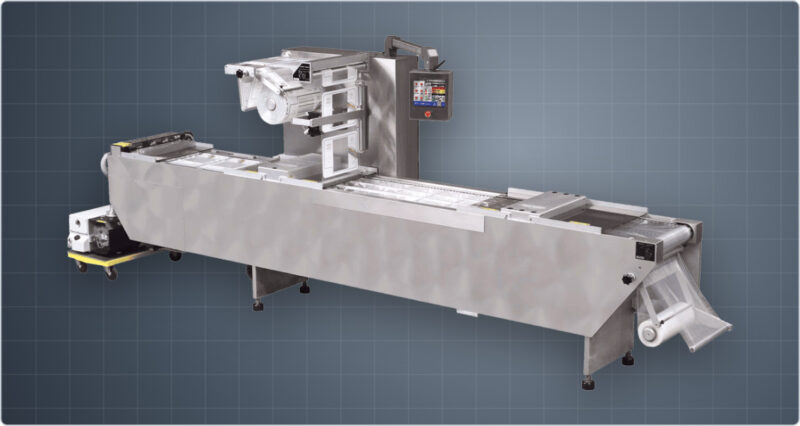
A thermoform-fill-seal machine heats and forms a lower roll of packaging material into pockets, then closes them with an upper web and cuts the sealed web into finished packages. Product is loaded into the open pockets before the upper web is applied, and air is removed or gas is added before sealing when the process specifies it.
The process is continuous in the sense that material moves through one integrated line, but the web normally advances in indexed steps. Each index positions the material for forming, loading, sealing, cutting, and discharge.
The process from roll to finished package
- The forming web unwinds and enters the film-transport system.
- The forming station heats the web and forms one or more pockets in the approved pattern.
- The web advances by the specified cutoff or index distance.
- Operators or automation place product into the open pockets while protecting the seal area.
- The nonforming web is applied above the product. Printed film may be positioned by registration controls.
- At the sealing station, air is removed and gas may be introduced according to the approved process.
- The upper and lower webs are sealed around the product.
- Longitudinal and cross-cutting systems separate the web into the required package format.
- Finished packs discharge for inspection, labeling, conveying, case packing, or another downstream operation.
- Scrap and side trim are collected or conveyed according to the trim-handling design.
The indexed cycle
An index is one controlled web advance. Several machine actions can occur during the same cycle at different stations: one section of web is forming while previously formed pockets are being sealed and another section is being cut. This coordinated motion is why a thermoformer can organize multiple packaging steps into one repeatable line.
Cycle time is influenced by the slowest required action. Heating, forming, loading, evacuation, gas flushing, sealing, cooling, registration, cutting, discharge, and connected equipment can each become the constraint. A faster drive or larger vacuum pump cannot solve every constraint.
What happens at each station
| Station | Controlled variables | Typical failure if poorly defined |
| Unwind and transport | Roll size, core, winding direction, web width, tension, tracking, registration. | Misregistration, tracking problems, wrinkles, unstable advance, or unusable film. |
| Forming | Temperature, dwell, pressure or vacuum, tooling, plug assist, preheat, material behavior. | Thin corners, incomplete pockets, distortion, bridging, or inconsistent depth. |
| Loading | Product orientation, temperature, pace, staffing, contamination control, support. | Missed pockets, contaminated seals, product damage, or rate loss. |
| Evacuation and gas | Pump capacity, porting, product porosity, headspace, gas method, dwell. | Residual air, product deformation, long cycle, or inconsistent atmosphere. |
| Sealing | Temperature, pressure, dwell, seal geometry, sealant compatibility, cleanliness. | Weak seals, channels, excessive peel force, cosmetic defects, or leaks. |
| Cutting and discharge | Knife type, package geometry, film stiffness, trim, support, timing. | Incomplete cuts, hanging packs, rough edges, jams, or damaged presentation. |
How output is calculated
Gross package rate is calculated from packages per cycle multiplied by tested cycles per minute. Packages per cycle equals the approved number of tracks across the web multiplied by the number of rows in the machine direction, subject to the cutting sequence and layout.
Example: a two-track by two-row layout produces four packages per cycle. If testing with representative product and film establishes 7.5 cycles per minute, the gross tested rate is 30 packages per minute. Practical production planning must then account for loading, changeovers, sanitation, planned stops, material interruptions, quality checks, and downtime. The example is a calculation method, not a general speed promise.
Why representative testing matters
Product behavior can change the process. Ground products may contain more trapped air than whole-muscle products. Liquids and marinades can enter vacuum lines or contaminate seals. Frozen, partially frozen, cooked, fragile, bone-in, sharp, porous, or irregular products place different demands on forming, evacuation, support, loading, and cutting.
Application speed is therefore established using the intended film and representative product under documented conditions. Acceptance should define package appearance, dimensions, seal, leak, peel, cut, registration, atmosphere when applicable, and sustained good output.
How Rollstock supports the process
Rollstock configures the machine around the approved package and process. Depending on the application, that may include film registration, vacuum capacity, gas components, preheat, plug assist, product supports, different cutting systems, printers, labelers, code dating, trim handling, loading-area extensions, conveyors, water management, and remote diagnostics.
The machine supplier proves machine and package-production performance against the agreed test plan. The customer remains responsible for its product, production controls, sanitation program, regulatory requirements, final shelf-life study, and distribution validation.
Related questions
What happens in a thermoforming machine?
The machine heats and forms a lower web into pockets, advances them to a loading area, closes them with an upper web, seals the webs together, and cuts the web into finished packages. Air is removed or gas is added before sealing when specified.
Read more: What Is a Rollstock Packaging Machine
What is an index on a rollstock machine?
An index is one controlled web advance. Several machine actions happen during the same cycle at different stations, so forming, sealing, and cutting overlap on different sections of web.
Read more: What Limits Actual Production Speed
How are thermoformed packages formed and sealed?
The forming station heats the web and forms pockets in the approved pattern. At the sealing station, air is removed and gas may be introduced, and the upper and lower webs are sealed around the product.
Read more: What Causes Weak or Inconsistent Seals
What controls cycles per minute?
The slowest required action sets cycle time. Any station or connected piece of equipment can become the constraint, and a faster drive or larger vacuum pump cannot solve every constraint.
Read more: How Many Packages Per Minute Can a Rollstock Machine Produce
How is package output calculated?
Gross package rate equals packages per cycle multiplied by tested cycles per minute. Packages per cycle equals the number of tracks across the web multiplied by the number of rows in the machine direction.
Read more: How Is Packages Per Cycle Calculated
Why does product testing affect machine speed?
Product behavior changes the process, so application speed is established with the intended film and representative product under documented conditions.
Read more: How Should a Rollstock Application Test Be Conducted
Technical and project boundary
The exact station sequence, settings, guarding, operating states, utilities, and maintenance procedures are machine-specific. Use the current manual and approved engineering documents for operation or service.
Next step with Rollstock. Rollstock can review representative product, film, package drawings, loading conditions, atmosphere requirements, cutting needs, and output targets to define a testable machine configuration.


